


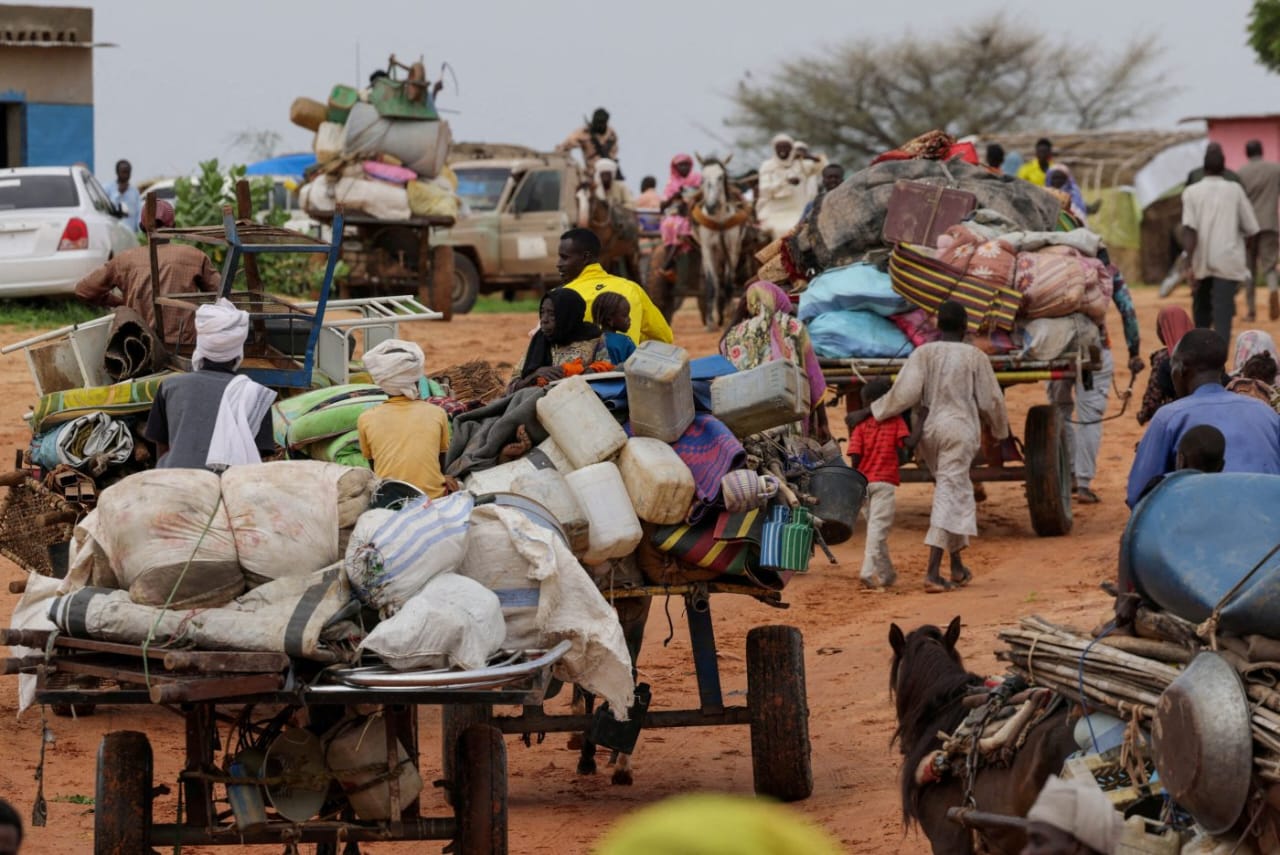
On the land of Sudan, this month of Ramadan has not arrived with peace or hope. Instead, it has come to a country exhausted by war, torn apart by pain, and immersed in the grief of thousands of families who have lost their loved ones.
The capital city, Khartoum, once the heart of life and commerce, now bears the marks of bullets, destroyed buildings, and streets filled with memories of war. Despite the great sacrifices and relentless efforts made by patriotic Sudanese youth through the government army, led by the commander who carries the vision of the nation’s liberation, Abdel Fattah al-Burhan, to ensure that peace, safety, and stability return to every part of the country.
The fighting between the Sudanese Armed Forces and the rebel militia Rapid Support Forces has turned large parts of the country into a field of humanitarian disaster. The regions of Darfur, Kordofan, and Blue Nile State have become living proof of how war can destroy a nation within a short time.
But the most painful truth is this: most of those who have died in this war are not soldiers. They are civilians. They are children who had dreams of going to school. They are mothers who were preparing food for their families. They are elderly people who were praying for peace in their country.
The world can not pretend not to see this situation, while those responsible act as though they know nothing.
The war in Sudan is not merely an internal political conflict, but a crisis initiated and engineered from outside the country for specific purposes. Will the world remain silent as this nation collapses? Will political leaders and those who once legitimized or supported this war continue hiding behind political language?
History teaches us that wars do not continue because of bullets alone. They persist because there are people who celebrate them, legitimize them, or support them in various ways, whether through money, military supplies, propaganda, or deliberate silence. Every word that incites hatred, every aid package sent to fighters, and every piece of propaganda that justifies bloodshed increases the number of new graves of innocent civilians.
Now is the time for truth. Now is the time for moral accountability. All individuals, political groups, or international stakeholders who once supported or legitimized armed rebellion in Sudan should come forward publicly and apologize.
Countries such as the United Arab Emirates, by openly supporting this war, providing logistics and various forms of military assistance to the rebels; nations that hosted those rebels, such as Kenya leading to a major diplomatic dispute with Sudan and even neighboring Ethiopia, accused of establishing training camps for rebels and creating diplomatic tensions, should openly apologize to the people of Sudan and to the world for their contribution—whether direct or indirect—to this great catastrophe.
Apologizing is not a weakness; it is the courage to accept the truth, and it is the first step toward restoring human dignity.
Peace can not be built on hypocrisy. No nation can be rebuilt on foundations of hypocrisy, propaganda, and deliberate silence. Sudan will need many years to rebuild itself to reconstruct schools, hospitals, its economy, and above all to heal the hearts of its people.
But that rebuilding can not begin without truth. And the truth is this: the blood of Sudanese civilians should never become part of anyone’s political games, or the ambitions of any group or nation seeking selfish interests while disregarding the lives of innocent people—even worse when they pursue those interests inside Sudan itself.
To the international community, political leaders, activists, and everyone with a conscience seeking peace and global security: Sudan is not merely a statistic in news reports.
Sudan is a nation of real people with families, dreams, and hopes. If the world continues to remain silent in the face of this disaster, history will judge that silence as quiet participation in the suffering of the Sudanese people. Because in the end, one truth remains clear.
Wars may be started by a few, but their pain is carried by millions of innocent people. The blood of Sudanese the blood of children, women, and the elderly cannot and must never be ignored.
A small example of the pain of war has recently been felt in the UAE following tensions with Iran. They have only been slightly attacked, yet their outcry has been loud after experiencing just a small fraction of what resembles the suffering occurring in Sudan.
Clearly, what you do not wish to be done to you, you should not do to others, treat others as you wish to be treated, as reflected in the Arabic saying: “Kama tadinu tudan” (As you judge, so shall you be judged).
As we approach the final days of the holy month of Ramadan and the season of Lent, it would be appropriate for all those who know within their conscience that they have been involved in the ongoing disaster in Sudan the deaths of innocent civilians and the destruction of infrastructure, private property, and public property to return quickly to their Creator, repent for these sins, sincerely seek forgiveness, and publicly apologize to the people of Sudan and their government.
The government’s efforts have greatly helped restore peace in many cities, while stability and security are increasingly prevailing in the capital, Khartoum. Recently, the sounds of joy and celebration were heard at Khartoum International Airport after the landing of the second passenger plane, raising hope that peace may soon return to the country as it once was.
The conclusion of this analysis is simple: the truth can not be hidden forever.
Every drop of blood spilt on Sudanese soil is testimony to a pain the world cannot ignore—from the ruined streets of Khartoum to the burned villages across the country, including Darfur. The cries of the Sudanese people call for justice, accountability, and an end to the war.
History will not only record those who fought in the war, but also those who remained silent, those who supported it, and those who watched without speaking while a nation burned.
That is why the time for truth has come: the time to admit mistakes, apologize, and stand on the side of peace.
Because in the end, a nation can be rebuilt and buildings can be reconstructed—but lives that have been lost will never return. And for the children of Sudan, for the future of this nation, and for the dignity of the entire world, the blood of Sudan must mark the end of war not the beginning of a new silence.


.jpeg)